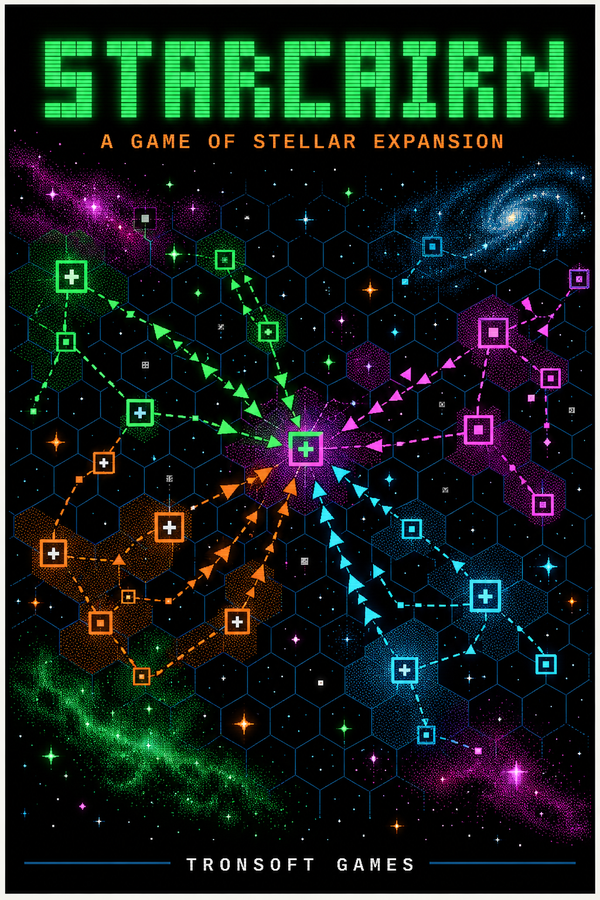
THE GOAL. Hold the cluster. You win by eliminating every rival, by hegemony (60% of all people and three times the next house), or by the best score when the last turn ends.
WORLDS. Each star has one world: TERRAN (holds 100 million), SUB-TERRAN (60), MINIMAL (30), BARREN (12) or HOSTILE (none until ECOLOGY 3). People make production points (PP); industry multiplies them. PP left unspent stay on the world.
BUYING. Select one of your worlds and spend its PP on the right: INDUSTRY, ECOLOGY (more room for people), BASES (fixed defence), SCOUTS, TRANSPORTS (carry 10 million colonists; costs the world 5 million) and WARSHIPS. Shift-click to buy as many as you can afford.
RESEARCH. A share of output goes to research, divided among six technologies. RESEARCH LABS add 30% research from their own world per level (up to 5), without increasing the output share paid. Ships keep the weapons and shields they were built with.
SENSOR ARRAYS. Build up to three on each owned world. Each adds two hexes to its scanning radius, beginning at four. Scanners reveal nearby star systems and detectable fleets; nebulae still hide fleets from distant sensors. Press I or SENSORS to display your scanner field.
STRATEGIC COMMAND. Press O for the command centre to see your population, economy, research, known contacts and exploration progress. Press K for the fleet registry: select any fleet and go straight to its map position to give orders.
MOVING. The cluster is ruled in hexes, one star to a hex, and every distance is a count of hexes. Select a world with ships, choose how many of each, press SET COURSE and click a star — or simply drag from your world to a star, or right-click a star. The course is drawn hex by hex with a mark where the ships will stand at the end of each turn. Ships may only go to stars within RANGE of one of your worlds (scouts half as far again). Orders resolve together when you end the turn.
SETTLING AND INVADING. Transports land by themselves at an empty world that can hold people. At an enemy world they land once its bases and warships are gone: 10 troops each against half its population — the course preview quotes the odds. At one of your own worlds they wait, ready to go on; press LAND COLONISTS to put them ashore there instead (not at the world that raised them).
BATTLE. Warships and bases fire every round; a hit depends on attack against defence. Enemy warships in orbit blockade a world: no output, and its people dwindle.
NEBULAE. Violet clouds of dust drift across the cluster. Entering a nebula hex costs 2 moves instead of 1, and a fleet inside one can only be seen from the very next hex. Courses run straight through them; the marks on a course show what the cloud will cost you.
REFITS AND BATTLES. Warships keep the marks they were built with. REFIT at a world brings its idle warships up to your present weapons and shields for 2 PP a point. Any battle can be replayed round by round from the BATTLES list or the world's panel.
DIPLOMACY. Once you have met a house (seen one of its worlds or ships) you can offer it a truce from the DIPLOMACY panel (D). Under a truce your ships share orbits without fighting, lay no blockade and land no troops. Houses answer by temper, by how strong you are and by recent fighting, and they remember a truce you broke. They make, keep and break truces among themselves too.
SKY AND MAP. Choose the shape of the cluster on the opening sheet: SCATTER, CLUSTERS, a RING with an empty heart, or TWO ARMS. Zoomed in, a small map in the corner shows the whole cluster; click it to jump there. Finished games go into the HALL OF FAME.
SPECIAL WORLDS. Some stars are marked on the map once surveyed: $ a RICH SEAM (output half as much again), + FERTILE (room for 30% more people) and Ω RUINS (the first house to settle there gains a burst of research).
FORTUNES. With fortunes on, now and then a house has an industrial boom, a plague, a derelict salvaged or a breakthrough. The ADVISOR on the left lists what needs you this turn; click a line to go there. EXPORT SAVE writes the game to a file you can IMPORT later or on another machine.
ONE COMMANDER. This is the solo edition: you command one house and the computer commands the other one to three. Each computer house sees only what its own scanners show and plays to its temper — an expander, a warlord or a scientist.
STANDING ORDERS. Give a world a standing order and it spends its own stock each turn: DEVELOP (industry, ecology, bases), ARM (bases, then warships), SETTLE (transports, then develop), BALANCED (develop, then warships), or SCIENCE (labs and sensor arrays, then industry). RALLY sends newly built warships to another star. AUTO-SURVEY sends idle scouts outward. UNDO returns the last purchase made this turn.
KEYS. ENTER end turn (unless a control is focused) · O command · K fleet registry · W next world · F next idle scout or transport · M set course · P rally · U undo buy · A auto-survey · L worlds · B battles · G charts · R range · I sensor field · D diplomacy · V sound · ARROWS pan (or pick destinations while aiming) · TAB next destination while aiming · ENTER confirm course · + − zoom · 0 fit · ESC cancel · N new game.